
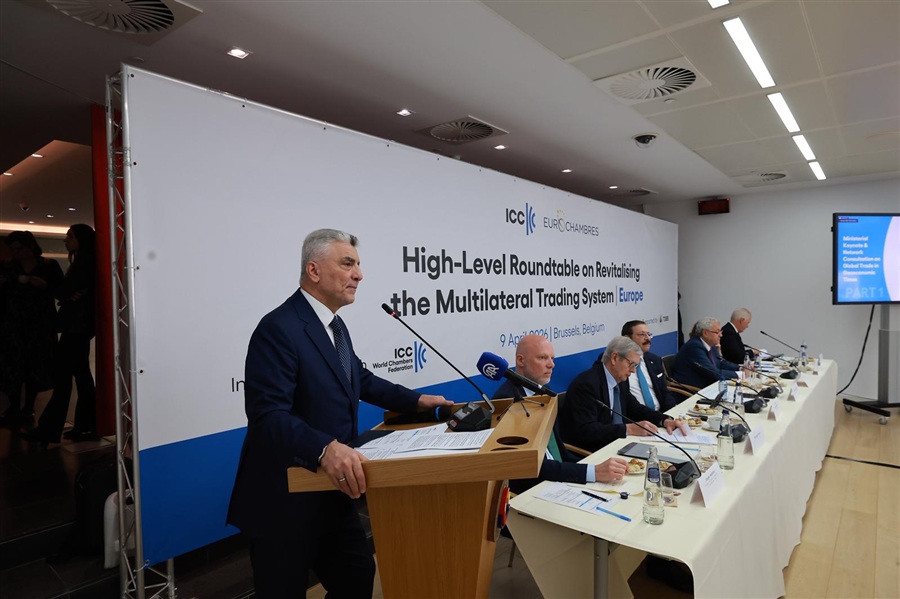
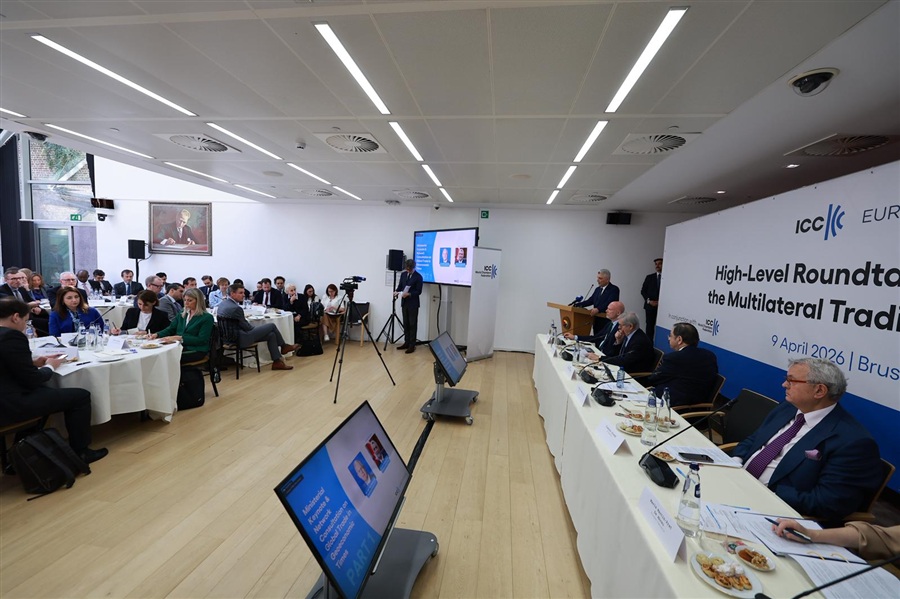
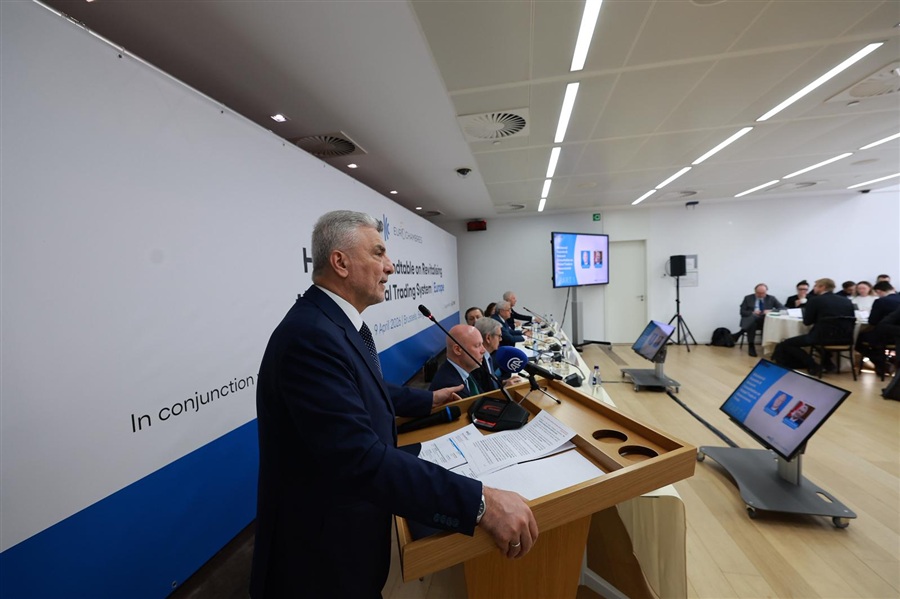
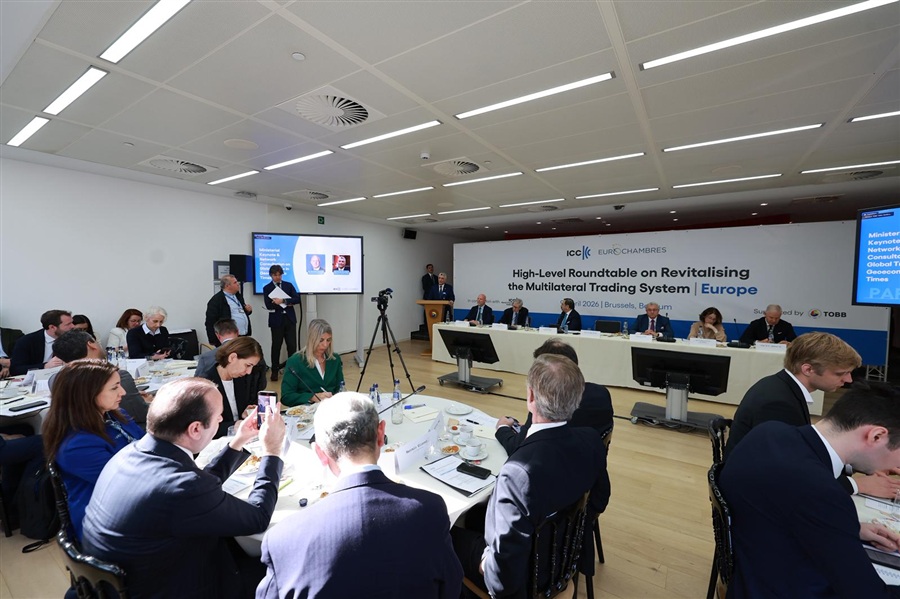
Turkey’s Minister of Trade Ömer Bolat highlighted the critical importance of modernizing the Customs Union to enhance supply chain resilience and unlock the full potential of Turkey-EU economic ties. Bolat made these comments during his keynote speech at a high-level roundtable on ‘Revitalizing the Multilateral Trading System’, organized in cooperation with the International Chamber of Commerce (ICC) and Eurochambres at the TOBB Brussels Representation.
Challenges in the Global Trade Environment
Minister Bolat addressed the audience at a time when global trade faces increasing unpredictability, rising protectionism, and intensified industrial competition. He noted that, despite the dynamic nature of trade, growth has slowed, uncertainty remains high, and geopolitical risks are deepening. Bolat underlined that while the global economy has shown resilience to shocks so far, this resilience is fragile.
He observed that almost all countries are working to diversify suppliers and trade partners, while moving production closer to key markets. Although markets remain interconnected, security and sovereignty now stand at the center of trade policy. According to Bolat, the global economy is becoming more fragmented, economic policies more interventionist, and trade in some regions is increasingly climate-focused, exposing the system to further geopolitical shocks.
Turkey’s Commitment to Fair and Multilateral Trade
Bolat underlined the serious challenges currently facing the multilateral trading system, emphasizing that all members need the predictability and reliability provided by rules-based systems. He stated that for Turkey, reforming the World Trade Organization (WTO) is not just a theoretical goal but a practical necessity for maintaining the system’s credibility and effectiveness. Bolat stressed the need to focus on shared principles that ensure fair trade for all and pointed out that existing blockages stem from a breakdown in trust between member states, not from the system’s core rules.
Turkey, he said, attaches great importance to strengthening fairness and equal competition in global trade. This includes addressing disruptive practices such as subsidies, excessive capacity policies, and other distortions. Bolat reaffirmed Turkey’s willingness to engage constructively in WTO negotiations in Geneva to work toward a more equitable, rules-based multilateral trading system.
Digital Economy and E-Commerce
Bolat also mentioned that at the recent 14th WTO Ministerial Conference in Cameroon, Turkey supported extending the e-commerce moratorium for two more years. He emphasized the importance of ensuring that this extension does not create unwanted imbalances, particularly for developing countries, and that any longer-term solution should be based on a shared understanding of the definition and scope of electronic transmissions.
Turkey-EU Trade and Investment Relations
Highlighting the complementary nature of Turkey’s efforts to strengthen the multilateral trading system and its regional partnerships, especially with the European Union (EU), Bolat explained that 2024 marks the 30th anniversary of both the WTO and the Turkey-EU Customs Union. The EU remains Turkey’s largest trading partner, while Turkey is the EU’s fifth largest overall and third largest preferential trading partner.
Trade volume between Turkey and the EU has increased ninefold, from $27 billion in 1995 to $233 billion in 2023. Around 70% of all foreign direct investment (FDI) in Turkey originates from Europe, with Turkey having attracted $289 billion in total FDI, most of which comes from EU and European countries. Bolat noted that the Customs Union has made Turkey an integral part of European value chains, especially in manufacturing, contributing to more resilient and diversified supply chains.
He welcomed the European Commission’s recent draft Industrial Accelerator Act, which provides a legal basis including Turkey in the interpretation of EU origin, but also pointed out that some uncertainties in the draft must still be addressed.
Looking Toward a Prosperous Future
Bolat warned that new measures planned by the EU from July 2026 risk weakening ‘deep economic integration’ unless Turkey’s preferential status within the Customs Union is recognized, and Turkey is not treated as a third country. He reiterated that modernizing the Customs Union is now a strategic imperative for increasing supply chain resilience and maximizing the potential of Turkey-EU economic relations.
Bolat concluded by affirming Turkey’s commitment to playing a constructive and proactive role within the multilateral system and its strategic partnership with the EU. He expressed confidence that, through modernization of the Customs Union and open, constructive dialogue, both sides can achieve tangible benefits for their economies and societies. With joint efforts and a forward-looking vision, current challenges can be transformed into opportunities, building a more inclusive, resilient, and prosperous future for both Turkey and the EU, as well as for the multilateral trading system as a whole.
Fotoğraf Galerisi


